ID: 
932
Maker's Name: 
GE, USA.
Where made: 
USA
Dimensions: 
3.7 × 3.7 × 4.8 cm

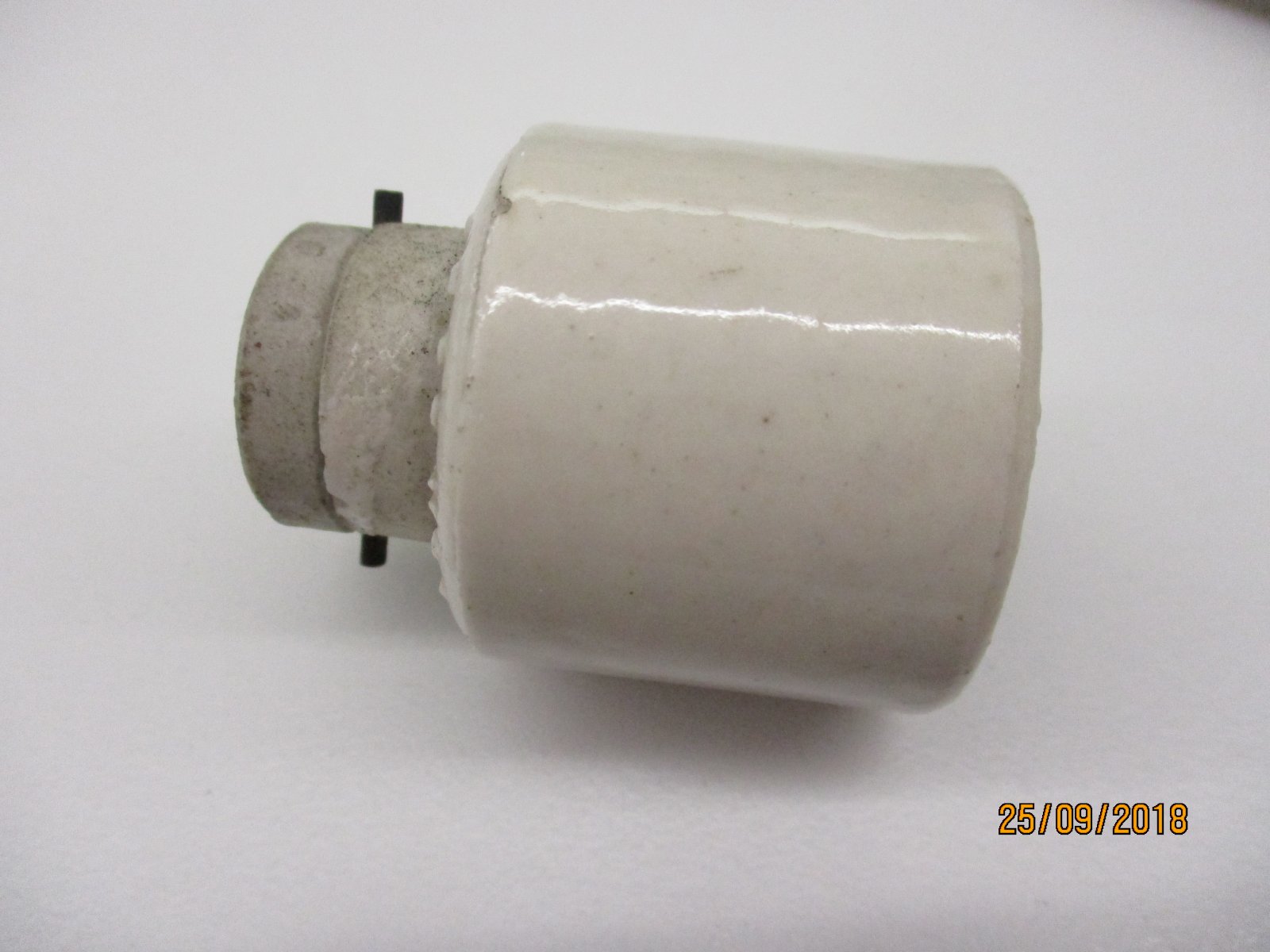
This adaptor allows an Edison Screw based globe to be plugged into a 2 pin Standard Bayonet Socket.
Tamworth Powerstation Museum

Tamworth Powerstation Museum

Published: 11 March 2013

I had a chance to visit, and got a two hour guided tour which still left most of the stuff to see next time. It is near the end of the main street, Peel St, and was a Bicentennial project based on the fact that in 1888 Tamworth had the first municipal electric street lighting in Australia.

The original powerstation was long gone, but in 1986 the Council decided to try to rebuild it on the original site. Amazingly, they were able to locate two John Fowler undertype steam engines of the correct type  and a couple of suitable boilers (which fit on top of the engines). There was no hope of finding a dynamo of the correct type so two 18 kW working replicas were constructed locally on the basis of 19th century sketches. Subsequently drawings have surfaced confirming the accuracy of the replicas, and another steam engine and generator similar to one used later has been obtained. All these are operated from time to time. Unfortunately not while I was there, but I did see the official Inspector of Boilers checking them out.

The original 1907 Municipal Electric Showroom now fronts a museum of all things electrical from measuring instruments through lamps and domestic appliances. It is not an enormous space but there are many thousands of items on display.  The horological highlight is a Smiths-Synchronome powerstation frequency checking clock. The one on display came from Hay but Tamworth had one in the day. The clock has multiple dials so that the time from the Synchronome clock part can be compared with the time from an AC synchronous motor clock (Smiths) running on the mains supplied by the powerstation. If the latter got ahead they slowed down the alternators a bit for a while, and if it got behind, they speeded them up. That way, everybody’s clocks were correct and all the equipment was happy working at the frequency it was designed for. Because the Synchronome clock normally impulses  only every half minute, this one is fitted with a seconds counter.  A magnet attached to the pendulum attracts a set of contacts together each time it swings past to drive a large two minute dial.

Down the back there are some other mains clocks but what really caught my attention was an original Reason electrolytic watthour meter. The Reason Manufacturing Company in Brighton, England is where Thomas Murday worked before coming to Australia in 1911 to run the workshop at Prouds  Electric Clocks and Scientific Instruments in Sydney. There was also a recording ammeter with a Murday patent recording pen. It was made by Elliott Brothers, another former Murday employer. And there was  a whole series of very well made electrical instruments by J. Durst, Sydney, whom I have never heard of before.

The Museum is open 9am-1pm, Wednesday- Saturday. Highly Recommended.


The fish that John West rejects

The fish that John West rejects

Published: 11 March 2013

We always knew that the whole collection would not fit in the new display space, but it has still been a wrench to box up the excess for transport to our storeroom at Long Pocket, about 5 km away.

It has become urgent now that  classes are  starting again because we have used teaching laboratory space as temporary storage and sorting space. We were not able to catalogue everything fully in the time available but we did tag most and photograph many of the items being sent away.  And we reunited a few orphans with their mothers.

The display space is pretty cluttered, but visitors should think of it as a Cabinet of Curiosities rather than a Modern Art museum. Or like a nineteenth century picture gallery with paintings floor to ceiling.

More exciting than sending stuff away is the development of our new website, in the hands of Mr Stuart Rowlands. More later: you will be impressed!

Norman Heckenberg

PS: The director's desk has moved to Physics Annexe (6), Room 318 on UQ's St Lucia campus.

Welcome to the new UQ Physics Museum website

Welcome to the new UQ Physics Museum website

Published: 17 March 2013

If you are reading this, you have found your way to the new UQ Physics Museum website. It is still under construction, but you are welcome to look around so long as you are wearing a safety helmet and high visibility vest.

If you are looking for some specific information, you would be better off to go to the old website at

http://www.physics.uq.edu.au/physics_museum/

We are transferring data from there but it is all being done by volunteers, so may take a little while. A lot of other data we have is also being added, as well as new functions, such as QR code recognition, enhanced searches, and virtual tours that can also be used as audio tours within the real museum itself.


Blog Archive

Blog Archive

Previous blog entries from the Director's desk will be archived here.

Check out Professor Heckenberg's blog on the museum's refurbishment!


SIS Tour of Switzerland - Day 1

SIS Tour of Switzerland 1

The Scientific Instrument Society organises a study tour each year, a sort of multi-day museum crawl, and this year it is in Switzerland. I have always wanted to go on one, and now that I dont have classes to worry about, I can. So Kerry and I are in Geneva, and today was the first day. We set off at 7:30am for CERN, and were lucky to have SIS member Erik Heijne as a guide. He has developed the silicon array detectors that are used in thousands in the Compact Muon Solenoid that was recently used to 'discover' the Higgs boson. We drove the 10km into France to the other side of the LHC and were able to go down into the cavern 90m below and see the detector. Big. And literally thousands of km of connection wires.

Another highlight for lovers of old stuff was a sneak pre-opening preview of CERN's 60th aniversary project. They have turned the remains of their first accelerator, the synchro-cyclotron, into an exhibit. It has a great son et lumiere show where diagrams of the internal operations are projected onto the machine, along with a stirring narration. We had lunch in the CERN canteen along with thousands of others. The food was good.

Before we left we made a pilgrimage to see the surviving server that Tim Berners-Lee used to run the first World Wide Web in 1989.

Back in Geneva city we visited the Voltaire Institute and Museum in a house he lived in for some years. The curators got out some nice manuscripts to show us, like letters he had written, and drafts of plays, and also a first edition of Diderot's Encyclopedie that he had contributed to, and his book on Newtonian philosophy. There was a portrait of his lady friend  Emilie du Chatelet, who translated Newton's Principia and was one of the first to propose the idea of kinetic energy proportional to the square of velocity.

This is one book he did not publish anonymously.

SIS Tour of Switzerland - Day 2

SIS Tour of Switzerland - Day 2

The threatened bad weather held off off for another day and it was glorious in the Perle du Lac gardens on the bank of Lake Leman as we arrived at the former mansion that serves as the museum of the History of Science. It had been opened specially for us and there were too many highlights to list, but I found that I was far from the only person on the tour who had never actually seen a George Adams orrery being cranked. It sounds like a coffee grinder.

And we had a lovely time discussing its various peculiarities with spurious moons and planets. The hygrometers and other meteorogical instruments that de Sassure took into the mountains were interesting, especially his sky-blueness-scale. On the balcony was a tide gauge used to measure the 73 minute resonant tides of long, thin, Lake Leman. Upstairs was an original Volta pile.

Even the toilet had a display.

After lunch at Le Pied de Cochon in the old city we split into two groups to visit the Patek Philippe Museum and the antique instrument shop of SIS member M. Perret nearby.

I found the conspicuous consumption aspect of the PP products a bit distasteful, and it is strange that the Calvinist burghers of Geneva would never use such things themselves, but as our guide observed, 'Money does not smell'. But there was a whole floor of pre-PP watches, very nicely displayed, and the 'most complicated watches ever made' were amazing. Unfortunately, no photographs allowed, and we did not get any special treatment here.

PP also made the first portable quartz clocks and supplied the readout clocks for the HP cesium atomic time standards in use since the 1970s. There was a wonderful collection of tools of all sorts but our guide was a bit weak on the technical side, and we had to get to the shop. It was quite a candy store and I spent a long time looking for something I could buy with the 50 francs pocket money Kerry had given me. But I found a little 'flea glass', only twentieth century, but with its instruction sheet.

In the evening, we took in the optional concert with the Geneva Chamber Orchestra in the Batiment de Force Motrice, a late nineteenth century hydroelectric power station. All the generators had long gone to the scrap man but some of the iron pipework had survived and was nicely lit to add to the atmosphere. The orchestra was good.

SIS Tour of Switzerland - Day 3

SIS Tour of Switzerland - Day 3

This morning straight after breakfast we set out in the bus, headed for Berne via Lausanne. The weather varied from poor to passable, but we got a very warm welcome at the Ecole Polytechnique Federale de Lausanne  where, since his retirement, Prof Jean-Francois Loude, has been setting up a Physics Museum that is more like ours than most. He was excited to meet me as we are the only two museums on earth to have Eotvos balances in their collections. So he reckons, anyway. After an introductory talk, we split into two groups, one to look at the displays, and the other to visit the storeroom, where we learned a new word: vistemboir  meaning mystery object as we were tasked with identifying some. They were pretty hard and Jean-Francois remained unconvinced by any of our theories.

We joined up again for coffee and croissants and then swapped venues until lunch of emince de veau avec champignons (known down the road as Zuricher geschnetzletes, an old favourite of mine) in the campus restaurant.

The clouds cleared for long enough to give glimpes of the mountains across the lake. It is a beautiful campus, and all the buildings, set in meadows, have fanciful names like 'Le Cubotron'.

They have quite a good website too. Give them a few hits at: http://museephysique.epfl.ch/

Then it was a sleepy ride in the rain to the hotel Baeren in Berne where we quickly checked in and then reboarded the bus for a painfully slow grind through heavy traffic to Bienne and up and up and up to the little village of Evillard where SIS member M. Dubuis had invited us to see his collection. He said his apartment was too small, so he had brought about 250 aneroid barometers to a local restaurant. And then 'found a sponsor' to pay for a three course meal for all of us. The sad part was that he is gravely ill and was out of hospital just for the night. But he clearly enjoyed seeing us all enjoying the collection. There was every imaginable form of aneroid barometer, combined with clocks, thermometers, hygrometers etc, and all the major types -Vidie/Dent, Bourdon, and Paulin were well represented. We were fascinated by an unusual null reading type invented in Zurich.

M. Dubuis had bought out a barometer factory some time back and handed out aneroid capsules. I got a couple of good ones in case the one in the Murday Microbarometer needs replacing. I showed M. Dubuis some pictures of it and he said I was lucky he did not see it on eBay.

After our creme brulees we had to reboard the bus in the rain and hurry back to Bern before our driver exceeded his 12 hour limit.


SIS Tour of Switzerland - Day 4

SIS Tour of Switzerland - Day 4

Today's goal was to explore the area around Neuchatel, birthplace of some of the greatest horologists ever, like Abraham-Louis Breguet, and at one time source of over 60% of the world's watches. Neuchatel itself is a beautiful town perched on the edge of its own lake, and we had time for a wander before the museum opened. We found a market and tasted some 'truffle caviar' and had  coffee and patisserie to keep us going. Inside the museum we split into two groups and took turns to explore the collection and to enjoy an hour long demonstration of the famous Jaquet-Droz automata. They were built in the 1770s by Pierre J-D, his son Henri Louis and an assistant, Jean-Frederic Leschot, and were shown all around Europe. They all look like child prodigies, perhaps like Mozart and his sister.

L'Ecrivain can write a message of up to 40 characters using a quill pen that he dips periodically into a little inkwell. The motions are controlled by a series of cams but the order is programmable by fitting tokens into a program wheel at the back. It is fiddly to adjust and takes all day to get right, according to the curator. At the moment he writes ' Jaquet Droz et Leschot'.

La Musicienne plays an organ that has 48 pipes. She really does play the organ with her fingers, which is demonstrated by the way the music stops if her hands are lifted. She knows 5 melodies, all written by Henri Louis. She breathes gently and makes an elegant (or haughty) bow at the end.

Le Dessinateur can use a pencil to draw 4 different pictures. Although he is much simpler internally, and not programmable (without rebuilding), he is the most charming.

Kerry was lucky enough to secure his drawing of a dog, labelled 'mon chien' to bring home.

We found some crepes for lunch and then headed into the hills to La Chaux de Fonds, a city built around clock and watchmaking, and home to the Musee Internationale d'Horlogerie. This is a really big one, with thousands of clocks, watches and tools on display. Unfortunately, the guides available were not very technically oriented so we did not get the most out of seeing the reproduction they had made of de Dondi's Astrarium, a late medieval astronomical clock of amazing complexity, and bypassed the reproduction Antikythera Mechanism entirely. But the time was still filled with interesting and beautiful objects, and I secured a bundle of cheap catalogues to practice my French on.

In the next valley lies Le Locle and our bus driver and his crazy-brave GPS took us on the shortest route over the ridge on a tiny windy road. When we reached our destination, the Musee d'Horlogerie du Locle in the Chateau des Monts above the town, we realised that we had a string of over 50 cars built up behind us. The chateau was built by a successful watch entrepeneur and housed several collections of clocks and watches from the vicinity, as well as a more general historical collection. Kerry especially liked the mechanical silkworm among the automata and the collection showing the evolution of Neuchatel-style clocks was interesting too. They had a 3D video presentation too.

By this stage we were all exhausted, and boarded the bus in anticipation of dinner. The bus driver outdid himself by taking us up a track forbidden to most vehicles to within about 500m of our goal, the Auberge de Mont-Cornu, but could go no further. So we walked the last bit while he went back to the main road and came in the front entrance to the car park. Meanwhile we enjoyed aperitifs outside as the sun set and then went inside for fondue and local wine until we could take no more. The bus trip back to Bern was uneventful.


SIS Tour of Switzerland - Day 5

SIS Tour of Switzerland - Day 5

Our last day was spent in Bern itself. As usual, we split into two groups. One went first to the Museum of Communication and the other to the Zytglogge and the Einsteinhaus, and then we swapped. The Museum of Communication addresses its subject at all possible levels and is strongly oriented towards children, of whom there seemed to be an unending supply. So some interesting old telegraph equipment including a mockup of Samuel Morse's prototype telegraph sender were in a dark room with flashing lights etc. To be fair, there was an interesting section on Reis' 1861 telephone demonstration using the sentence 'Das Pferd frisst keine Guerkensalat' (Horses dont eat cucumber salad). But the section a guide took us to on the history of computing in Switzerland was well laid out and lit and had many icons like  a pre-computer IBM card writer/sorter and a Z4 and the first computer built by the ETH and an IBM 360 and an Apple 1 and a prototype mouse from Xerox PARC and....the guide had us swapping yarns and everybody had a good time. But as I mentioned before, the other bits were a bit boring for us old folk and we gravitated to the cafe even before the appointed time.

But then we were off to see the astronomical clock in the centre of town that people like to say Einstein walked past on his way to the Patentamt each day.

It is a nice clock, with an astrolabe type dial and a crowing cock and a procession of bears (the symbol of Bern (=Baeren)) and a knight who strikes a bell high above. But in the passage underneath is a collection of standard lengths like a Bern foot and various others.

It was almost noon and a crowd was gathering to see the show, but we were able to climb up a spiral staircase to the clock room and see the 1530 mechanism in action.

It still has a verge escapement, although not the original verge and foliot, but since the seventeenth century (?) it has had a pendulum with a massive 100kg spherical bob.

We saw the bellows that makes the cock crow, and the drives to the astronomical dial ( which seems to be earlier still),  the bear carousel, and the bells.

The guide then led us up the cobbled street to the Einsteinhaus which is Albert and Mileva's flat and another floor for library and research centre.

We were met by Prof. Dr. Hans-Rudolf Ott, President of the Einstein Society, who gave us a short talk about AEs work and family life around the magic year of 1905.

He had little time for the theory that Mileva had come up with all the ideas, but concluded that although Albert had been one of the greatest scientists of all time, he had not been a successful husband or father. We then went upstairs to join the throng of visitors and look at the tiny flat.

We had the afternoon free, so Kerry and I went to the Zentrum Paul Klee for some light relief before the closing dinner of the tour.

That was a pretty informal affair at a micro-brewery with a to-die-for view of the city in the Altes Tram Depot. I had brought a suit and society tie all that way, and Kerry had a crushed silk dress for the occasion, so we were pleased to see that everyone else had put on their best gear and we all had a jolly time. It was a bit noisy for speeches but we did our best to thank Marcus Cavalier and his wife Sarah for organising such a smooth and instrument-packed trip.

As a final gesture, we trundled our bags the long way round to the Hauptbahnhof the next morning to see the Patentamt where AE had worked (48 hours a week while he was doing Brownian Motion, the Photoelectric Effect and Special Relativity!)

The End

SIS tour - Coimbra postscript

SIS Tour - Coimbra postscript

Rather than returning home immediately after the SIS tour, we decided to spend a few days in Portugal before facing the trip home.

Portugal is much cheaper than Switzerland, and just as nice in its own way. Coimbra is a very old university town that is also a major tourist attraction, partly for the university buildings, which include a chapel completely lined with the blue and white tiles so popular here, and the neatest library I have seen, large and tall and dim with thousands of gold tooled books in gilded shelves, and harbouring a colony of bats that are supposed to eat any insects that blunder in. There is a university prison downstairs.

http://en.wikipedia.org/wiki/Biblioteca_Joanina

Less popular than the library is the university science museum. It is headquartered in a palatial building that was originally the chemistry school

http://www.coimbraportugal.org/attractions/science-museum-coimbra

Inside there was a  exhibition on 'Light and Matter', with a nice mix of old instruments and modern interactives suitable for school kids, housed in the old chemistry laboratories. Some of the old lab benches have been preserved and the old tile and oak fume cupboards are used as display cases. In another part, there is an exhibition on the old links between Portugal and the Orient, especially the Jesuit astronomers who went to China and sold them one of the few things the Chinese wanted from the west ie more accurate astronomical calculations based on Kepler's Rudolphine tables. Somewhat related was a 1692 decree that the teaching of mathematics in Portugal should be improved. One result was the production of wall tiles for teaching mathematics:

But across the road was what we had come to see. In its original position is the old Physics lecture theatre from 1772,

with suitably uncomfortable seats, and next door, two large rooms full of lecture demonstration apparatus from the 18th and 19th centuries.

Most of the items were readily identifiable from the pretty minimal labelling, but others were more obscure:

Although I could log in to eduroam with my iPhone, for some reason I could not find the excellent website

http://museu.fis.uc.pt/catalogoi.html

(probably just impatience and the tiny screen) so had to go ignorant.


2015/2 Big calculations

2015/2 Big calculations

On a recent trip to Japan, I chanced upon a shop selling scales and other instruments in a back street in Kyoto.

Mixed in the rather haphazard window 'display' were two Japanese abacuses or soroban.

Last time I had been in Japan was in the 1980s, when electronic calculators had taken over nearly everywhere, except at the Japan Rail ticket office where a machine printed the tickets but a soroban was needed to add up the total cost.

Now you see them only at flea markets, and as icons. Racoon-dog monsters often appear outside bars and restaurants to encourage patrons to spend and have a good time: this one had a soroban to keep tabs.

Gettting back to the examples in the instrument shop, what struck me was the range - the larger one could handle numbers up to 10 37 !  The shopkeeper appreciated my interest but we could not communicate, so I remain ignorant of what purpose it could possilby serve. 10 37 is a seriously large number - more than all the petals on all the flowers on all the cherry trees in all of Japan in Spring.

2015/3 A good museum is hard to find

2015/3 A good museum is hard to find

Science museums have a hard time getting into guidebooks, especially instrument collections.

So let me share a couple for anyone planning a trip to Japan. Everyone will (and should) visit Kyoto, and while the standard attractions are wonderful, the devoted student of scientific instruments will want to visit the Shimadzu Foundation Memorial Hall.

It is right in the city and commemorates the rise and rise of the Shimadzu corporation over the last century from its beginnings in this building.

As an anime DVD hagiography explains, Genzo Shimadzu started the business making Physics teaching equipment and then moved into research and diagnostic systems.

They started with exact copies of American  equipment and continued to do so even after the end of WW2. But they are very proud of their more recent original research with a staff member, Koichi Tanaka sharing the 2002 Nobel Prize for Chemistry.


The museum is not large, but is very stylish, and has a particularly impressive early diagnostic x-ray setup with a giant HV generator named "Diana".


Peter Hadgraft is now building a cardboard model of it that I brought back.

Not far away is a canal museum and railway for transferring barges between canals but I did not have time to visit it. It is a good place to view cherry blossoms, though.

I did not find much old technology in Tokyo, but the small city of Matsumoto had plenty. We had come to see the famous castle and the ukiyo-e museum, but a diligent search of the local guide brochures revealed the existence of a Timepiece Museum, a Wireless Museum, and a Scale Museum. We had time to visit only one, so chose the Scale Museum.

It was in a traditional building that had formerly been a shop sellling scales and other metrological instruments, and has a small but interesting collection.


Some of the most interesting were scales used for separating the cocoons of male and female silkworms.


I also liked the little square wooden boxes with a volume of one go (180 ml) originally used for rice but now mainly for serving sake. (The photo below was taken elsewhere, there is now one in the Physics Museum collection)


The attendant would not let us leave without serving us tea in the tatami-matted library.

The castle is good too.


2015/4 More audio tours

2015/4 More audio tours

When we set up the new web-based catalogue for the museum we built into it the ability to host and play audio files as well as images.

Coupled with a filter function, this allows us to set up audio tours that can be accessed using a smartphone.

Two third year students, Sarah and Joshua, have been working on making the tours a reality by composing and recording the the audio tracks, and eight are now complete (not the first one in the list!)

The easiest way to access them is at the lower left hand side of the museum homepage.  Once you get to the page for a particular item in the tour you will see an audio file player - click on that and listen.

Recently, a representative of a Dutch startup has been in Australia encouraging museums and other groups to make use of a free smartphone app that already accesses hundreds of museum and city tours.

The izi.TRAVEL app is available free from the app store for your smartphone, or from https://izi.travel/en/app

A number of members of the Brisbane Living Heritage Network have contributed already, and the Physics Museum now has an introductory tour recycling some of the content we already have. We we hope it may rmake our little museum a bit easier for people to find.


2015/5 Werris Creek Railway Museum

Werris Creek Railway Museum

Recently I had a chance to visit the museum in the imposing old station at Werris Ck, NSW.

It’s not the usual railway museum with locomotives and royal carriages but concentrates more on the people who operated and maintained the whole system. The main part of the museum is in the former refreshment room where hundreds of hungry people would arrive late in the night for the famous (so we are told) pies and coffee. I could now reveal to you the secret of making real railway coffee, but I will spare you. There are many fascinating relics, like models to teach staff how to load and lash down bags of wheat on a wagon, and watches and lamps and telegraph gear.

We were lucky enough to be shown some not yet complete exhibits upstairs by a volunteer.

Apart from a HO model train layout based on the local tracks, the exhibit that really intrigued me was the controller’s desk for the Sydney North area (ie everywhere in NSW north of Sydney).

Apparently it operated from 1934 to 1991. The controller used a giant position/time graph that covered the whole desk to schedule train movements and arrange where they ‘cross’ ie potentially are at the same place at the same time. He could contact stations and signal boxes by hands-free telephone using a special clockwork speed dialling knob for each one.

If you are travelling down the New England Highway it’s an easy detour between Tamworth and Willow Tree to visit Werris Creek.

http://www.lpsc.nsw.gov.au/files/download/WerrisCreekRailMuseum.pdf


2015/6 Steam Powered Website Launch

2015/6 Steam Powered Website Launch

Tamworth Power Station Museum has a new website.

Seriously, it is powered by  a Collections Mosaic catalogue database, but it was launched on Monday, the 127th anniversary of the switching on of the electric streetlights in Tamworth, in a cloud of steam from the two Fowler double-acting cross-compound semi-portable undertype steam engines that recreate the original 1888 power station.

Local dignitaries were there to cut a ribbon draped over a monitor, and to help launch a book about local hero V. Guy Kable, for many years Town Clerk and Chief Engineer in Tamworth, and lots of local people stopped by to enjoy the occasion. The website allows users to search the museum catalogue for information on objects on display, but also for more general information on manufacturers and reference material held. Not everything is yet in the database, but the home page leads directly to some representative items in the collection. They range from the very technical to the very domestic as the collection includes not only switchgear and instruments used by the council engineers, but also domestic appliances, many donated by local residents after decades of faithful service. And more different sorts of lamps than you knew ever existed.

The website also has some striking panoramic images of the museum rooms that give the virtual visitor an idea of what a rich collection is squeezed into quite a modest space. For those able to make a physical visit, the website can be accessed within the museum on a smart phone with QR codes taking him/her directly to catalogue entries for some of the star exhibits.

The url is http://tamworthpowerstationmuseum.com.au/

The website will also tell you the date of the next  Running of the Steam Engines.

I wish we had a steam engine.


2015/7 Goodbye IPL

2015/7 Goodbye IPL

To round out the International Year of Light, the Tools of Science meeting last Friday took the form of a hands-on holography workshop led by Dr Margaret Wegener.

Margaret had also been involved in the Light Play exhibition in the UQ Art Museum, and participants had a chance for a last look at that before it closed.

It featured a large white light reflection hologram by celebrated Australian artist Paula Dawson as inspiration.

Eighteen participants, ranging from retirees to school students, were able to make classic transmission holograms using Litiholo 'instant' holographic recording plates and diode lasers.

Margaret had been running workshops for school groups through the year, and was pretty relaxed and confident.


The photo shows one of the setups illuminated by a 'safe' blue laser diode.  Everyone set up and started exposures in the dark, and we repaired to the Physics Museum to talk about holograms and lasers for about twenty minutes.

On our return, all the setups had produced holograms that could be 'reconstructed' using the same diode laser as was used for the recording.

Everyone was happy. (thanks to R.I. for the photos)

2015/8 Medieval Power

2015/8 Medieval Power

Medieval Power may sound a bit like the latest reorganisation of the electricity industry but it is actually the title of a British Museum travelling exhibition now being hosted by the Queensland Museum. The advertising stresses ‘ the precious gold, jewellery, seals, sculptures, stained glass and many other symbols of courtly life alongside tools of war, objects of religious significance and humble items from everyday life dating back to AD 400’, but there are also several items of real interest to the more technically minded. You can find more information on the BM website.

In this respect, the star is the Blakene astrolabe, the earliest signed and dated (1342) European instrument known.  

http://www.britishmuseum.org/research/collection_online/collection_object_details.aspx?objectId=54861&partId=1

It is a really nice one, with an elegant rete with a quatrefoil rather than arabesques, and  gothic Latin script. It is signed Blakene me fecit anno do 1342. It’s a pity one  can’t see the back, but..

Another item worth seeing is the ‘world’ map of 1482 by Johannes Schnitzer . It was actually meant to be an illustration for an edition of Ptolemy’s Cosmographia, so I think more was already  known about Africa than is shown here, but it is a lovely map.

Another gem that is not a gem is an anonymous engraving from 1464 (circa) about Mercury.

http://www.britishmuseum.org/research/collection_online/collection_object_details.aspx?objectId=756441&partId=1&searchText=mercury+1464&page=1

There is an explanation printed below but unfortunately the BM does not provide a translation.

Can anyone help?

 Mercury is flying, very luxuriously above Florence, which seems to be well into the Renaissance already, and the local people are engaging in characteristic artistic activities. In the middle of the picture are some astronomers or astrologers with an armillary sphere, but don’t miss the weight-driven wall clock on the right. The engraver has even shown the foliot at the top. The pendulum was still 200 years away.

Elsewhere in the exhibition, there are some interesting balance weights, and of course, all of the pomp and power items promised. Just to mention three, there are chessmen from the Lewis set, and, as it was getting towards mealtime when I visited, I was attracted to a quirky drinking horn

http://www.britishmuseum.org/research/collection_online/collection_object_details.aspx?objectId=46880&partId=1&museumno=AF.3127&page=1

and a nutcracker

http://www.britishmuseum.org/research/collection_online/collection_object_details.aspx?objectId=42929&partId=1&searchText=nut-cracker&page=1

2018/11 Weighty Matters

2018/11 Weighty Matters

You may have seen something in the press about the kilogram no longer being defined in terms of the platinum-iridium International Prototype kept in a vault in France.

It is over 125 years old and discrepancies have developed between it and several others made at the same time. But the change is much deeper than just getting a new prototype. The kg was the last basic unit in the SI system that was not defined in terms of a physical constant. The second is defined in terms of a cesium atom oscillation, the metre in terms of the second and the speed of light, and so on. Now, by fixing the value of Planck's Constant and using a Kibble balance, objects can be weighed in terms of an electric current.

Most countries in the world, apart from the USA, now adhere to the SI system. Another exception is Myanmar where I travelled recently. They use a mix of units. Miles serve for distances on roads where vehicles drive on the right but most are right hand drive second hand from Japan. Weights may be in kg or pounds or viss (1 viss = 1.63 kg approx). To someone interested in measurement and units, sighting such an endangered species of unit is exciting. Back in the day, the King would own prototype units, usually bronze castings in the shape of mythical beasts, and merchants would source their own and have them certified by comparison with the standard. The British brought with them more prosaic cylindrical weights, but the old weights are very decorative and collectible, generally going under the name of 'opium weights'.  I could not resist collecting a few, some of which might even be genuine. In fact, Myanmar has announced that it will embrace the SI system soon, although whether it will root out the old units as ruthlessly as the Australian government did back when we 'went metric' remains to be seen.

I suppose the International Prototype Kilogram is now equally superfluous, but I expect I would have to join a long queue to get my hands on it. The platinum must be worth over $25000. At nearly $1500 per troy ounce (another unit in my crosshairs!)  iridium is more expensive than platinum. The National Measurement Laboratory in Sydney holds copy Number 44, which could come in handy next time the government cuts their funding.


2018/5 Museums in Turin

2018/5 Museums in Turin


Turin is a very elegant city in the north of Italy, within sight of the Alps on a clear day, and not overrun with tourists (yet). It has several high profile museums of world class, but also some lesser known ones of interest to lovers of old science and technology.

The Egyptian Museum has a beautifully displayed collection rivalling those in Cairo and London that includes some measuring vessels and cubit rules. The Cinema Museum has a wonderful collection of pre-cinema optical devices like anamorphic mirrors, peeps shows, phantasmagoria, and magic lanterns.

What you will unfortunately not find in the guide books are the fascinating collections held by the University of Turin. https://en.unito.it/galleries/astut-and-other-collections I believe there are others too.

The Physics Department has a lot of instruments in cabinets in its corridors, and a staff member who uses them for didactic purposes. Although the university dates back to 1404, most date from the late nineteenth century, and are related to electricity and magnetism and optics, and they are beautifully displayed with LED lighting.


Not far away, a group of three small museums makes for a memorable visit. See some pictures here. The most charming is the Museum of Fruit, basically a collection of very lifelike wax models of hundreds of different types of apples and pears and other fruit, and also some vegetables too. These were made for teaching and research purposes back in the nineteenth century and are a great reminder of how much biodiversity we are losing. The second is the old anatomy museum, left as a time capsule of objects and display modes. It is not too gory, and the wax models of internal anatomy are pretty interesting if you can’t remember things like where your spleen is.  One quirk is the skeleton of a former director with his brain in a jar alongside. Such is the devotion of directors to their museums. The third is a bit disturbing, featuring a collection of art made by inmates of insane asylums and hundreds of skulls studied by Cesare Lombroso in developing his theory that criminals represent a throwback to a primitive condition. His skeleton is on display too. This is giving me an idea….only joking!

Prof Marco Galloni, an anatomist by trade, is also the scientific director of a remarkable collection, the Archivo Scientifico e Tecnologico Universita di Torino. The name ‘archive’ was carefully chosen to imply that it was a collection not on display, but stored for researchers to trawl through. That said, until recently there were display areas open to the public and school groups. At the moment, the buildings, an enormous old tobacco factory in the suburbs,  have been declared unsafe and a new home is being sought. But I got a personal tour and it was amazing.

The items in the collection are mainly from the twentieth century and cover all areas of science and technology. There are literally stacks of computers (of course), but multiple electron microscopes, a whole operating theatre, the contents of a nineteenth century clockmaker’s workshop, and a pre WW1 x-ray setup. I think the highlight was the complete set of physiological testing apparatus used to screen potential pilots in the first world war- reaction time, ability to withstand accelerations, and even response to low air pressure in an evacuated chamber. In some other archive they found the applicants’ results! Like we did back in the day, they make some money hiring out items as props for movies and have enough furniture and other fittings that they can provide a whole laboratory.


2018/5 The Antikythera Mechanism

2018/5 The Antikythera Mechanism

The Antikythera Mechanism

Recently I joined a Scientific Instrument Society study tour to Athens.

We spent five days visiting museums and archeological sites as organised by local SIS members, and feasting on Greek food and wine.

Two highlights had to do with metalwork: a visit to the ancient silver mines of Thorikos, and the Antikythera Mechanism. Thorikos is in the south east of Attica, near Cape Sounion, and the silver from the mines there made Athens prosperous and funded the fleet that defeated the Persians in 480BCE and the building of the Parthenon. We saw only the entrance to a mine [https://www.heritagedaily.com/2016/02/archaeologists-discover-a-network-of-galleries-shafts-and-chambers-at-the-foot-of-the-mycenaean-acropolis-of-thorikos/109654], but more accessible were the remains of ore processing facilities in the hills. The ore (galena or chalcopyrites) was ground into a powder and then washed to separate the heavier metallic component as the lighter dross was washed away. The concentrate was then dried into bricks for transport to areas where there was wood for smelting. The water was cleverly recycled (everything was done by bucket and spade) and the washing and drying areas and channels and large cement-lined (!) water storage cisterns are still in quite good condition.


Back in Athens, the National Archeological Museum houses the Antikythera Mechanism, a truly amazing relic from c.100 BCE.  I must have walked right past it on my last visit in 1975, but recent studies have raised its profile and if you hunt a bit, you can now buy an Antikythera Mechanism tee-shirt in the tourist bazaar. It now dominates two rooms of the museum as is fitting for ‘the first computer.’ It happened to be International Museums Day when we visited, so entry was free and the whole museum was crowded.

The relic itself is not very prepossessing, especially compared to the wonderful bronze statuary that came from the same shipwreck, but you can certainly see gearwheels embedded in the three lumps on display. A sort of head-up projected animation of how the pieces fit together enlivens things, or distracts, depending on how you are feeling. Wall panels explain its function as a geocentric planetarium and eclipse calculator.

 A second room displays reconstructions of the device. These have an interesting history of their own and give a much better sense of what it is we are dealing with.  Right from its discovery in 1900 it was realised that it was some sort of astronomical device, but it is only with the use of xray scanning technology in the 1980s by Michael Wright (a SIS member but unfortunately not on the tour) and the late Alan Bromley (from Sydney University) that a real appreciation of its internal layout and its probable capabilities were possible. Bromley made a reconstruction with Sydney clockmaker Frank Percival that is now in the Nicholson Museum. A reconstruction made by Wright was on display, the first one to correctly interpret the arcs on the back as five turn spirals acting as eclipse predictors. Recent high resolution scans have even allowed some of the extensive instructions engraved on its front plate to be deciphered, confirming some speculations on its functions. As well as three earlier and two later reconstructions, this room also had a 3D video of the story of its discovery off the island of Antikythera.This was made by Hublot who make a Antikythera wristwatch and who are sponsoring further dives on the wreck. The video is available in 2D here. Another team has made a three times enlarged model largely of Perspex. We saw one at the Athens Observatory. It was good to see into the mechanism, but too easy to look right through it, so it did not help me too much in understanding how it worked.


  In fact one of the best ways to understand the device is to watch ‘Chris’ from Townsville build one on YouTube.https://www.youtube.com/watch?v=ML4tw_UzqZE&t=13s He also addresses questions of what tools were available to its makers.

It was exciting to hear that diving on the wreck is ongoing. It is suspected that the front of the device housed a geocentric planetarium but that part is largely missing. It will be a miracle if the tiny parts can be found, but we can all hope. The diving team do have specially developed metal detectors.

Later we took advantage of the free admission to have a quick look inside the Tower of the Winds that overlooks the Roman Forum (c.50BCE). Adorned with multiple sundials and a windvane, the tower also once contained a water clock of some sort, and looking at the substantial cistern and channels in the floor it is tempting to speculate that it housed some sort of water-driven mechanical clock rather than a simple klepsydra.


A new clock in the museum

2016/1 A new clock in the museum

I have recently put another electric master clock on display in the museum. What you see has taken many years to come together. The mechanism was given to me in the 1980s by the late Arthur Page, who had used it as the timekeeper in his observatory, with a gun cleaning rod as a pendulum. He had bought it from a junk shop and it was in a case many years its junior. Eventually I worked out that the mechanism was one of the first ones made here in Brisbane by the founder of the Synchronome Electrical Co of Australasia, A.G. Jackson, and pretty similar to one he installed in the Brisbane Central Technical College and University of Queensland at Gardens Point about 1916.

Years later, a case of correct age turned up, in shocking condition. It had been made in England,of walnut, but was the style that had been copied locally, in silky oak. But after clamping warped pieces straight for a few years, I was able to reassemble it. With the case I was able to get a dumpy lead pendulum bob. If you look at it long enough you can learn to love it too. I did not fit a dial in the case so visitors would be able to see the workings more clearly. Although the one at Gardens Point did have a dial inside, it was not uncommon to not fit one in those days as the 'controller' would be operating up to 100 dials, many in more convenient places. Here, there is only one dial up on the wall. Look for its hands jerking forward every 30 seconds.

For more information, look here.


A new exhibit

A new exhibit

I have just hung a new pendulum clock in the Physics Museum. It has a long history, most of which I don't know.

It was originally donated, maybe in the 1980s, by Arthur Page, a well known amateur astronomer and benefactor of UQ.  He had bought it from a second hand dealer and used it as the main timekeeper in his domestic observatory for many years.

It lacked a pendulum, so he had used a rifle cleaning rod. It was in a Brisbane-made silky oak case that dated from the 1930s. At first, I thought it was an amateur copy of a Synchronome clock, but later realised that it was a very rare, perhaps experimental, model made by A.G. Jackson in the very early days, around 1907, of the Synchronome Electrical Co. of Australasia in Brisbane.

Much of that history, deduced from letters Jackson exchanged with Frank Hope-Jones in London that came to light when a group of members of NAWCC Chapter 104 compiled a booklet on the company published in 1998 (G. Bianchi et al, SYNCHRONOME BRISBANE 1903-1991, NAWCC Chapter 104, 1998), is recounted in articles in Horological Journal by Tony Roberts and Norman Heckenberg.

A pendulum rod and bob were made according to instructions given in Chapter 6 of Hope-Jones’ book ‘Electric Clocks and How to Make Them’, Percival Marshall & Co. Ltd, London. That also post-dates the clock movement by many years.

The clock was at my home for many years, waiting for a complete overhaul, and somewhere to hang it, and just maybe, a more appropriate case. In 2009, a somewhat similar clock turned up, in very poor condition, in a case that could be dated to the first decade of the twentieth century as it had been made in England and could be compared with those shown in Robert Miles’ book ‘SYNCHRONOME Masters of Electrical Timekeeping’. The case was in such poor condition that the owner made a new one and passed the old one to me. It took several years to straighten the backboard (which has now been braced at several places) and part of the door, but in 2015 it was possible to reassemble and finish it. A number of missing parts were replaced with ‘fruitwood’ stained with ‘walnut’ stain to match the original parts. I could not replace the old locks so adapted some jewellery box locks. The whole case was finished with shellac as was used by Synchronome at that time.  The silvered nameplate and the dumpy lead pendulum bob were kindly donated by the former owner.

The result is something that will look rather like the master clock installed by Jackson in 1914 (Dec 31!) to run 112 dials all over the Central Technical College at Gardens Point. That campus included the building used by the recently established Queensland University, and in fact the company records show that a master clock was installed there on February 4, 1911. According to an advertisement, the case for that clock was locally made of silky oak, and it had a slave dial installed inside the case. I have not fitted one here as it would obscure the workings of the movement, and it was not uncommon in the early days to have no dial within the case of the ‘controller’.

In the museum, the master is connected to an enamel dial slave clock of similar vintage. In fact, until at least 2000 there was a similar one still over the front door of what was the University Building, now called Old Government House. I think it disappeared when the building was restored to a nineteenth century appearance.

There are some photos and links to more information at

https://physicsmuseum.uq.edu.au/synchronome-master-clock-1

Norman


Busy Busy Busy

Busy Busy Busy

The last month has been a busy time for the museum. We had our first school visit in the new space, with a group of year 11/12 students from Roma. They seemed to know their stuff and enjoyed 'shaking hands with your real image' once they stopped being shy. The class of ARTT2115 (Art, Science and the New Technologies) came one afternoon to see some astronomical instruments. I bamboozled them with an explanation of how to cast a horoscope using an astrolabe and let them look through a replica of the telescope Galileo used to discover the moons of Jupiter. Using a Powerpoint presentation on the screen at the end of the room worked well. That was another first time.

Dr Gary Tuck and colleagues have the UQiLabs radioactivity experiment now running in the display case at the foyer end. Students can log in and run the experiment remotely from anywhere in the world, so every so often it wakes up and lights come on and displays flicker and it sends some data and goes back to sleep.

The biggest news is that, after months of preparation, all the items that would not fit in the new space were moved out to our storeroom at Long Pocket yesterday. That frees up the teaching space we had 'borrowed' so it can  be used during the refurbishment of the rest of the ground floor of the building. Once again, Peter Hadgraft's assistance and encouragment were invaluable. Meanwhile, Joshua Melson has begun entering data into the website database, and I have organised the first part of the "100 Years of Physics at UQ" audio tour so I can show it off to guests at the UQ Celebration of Giving function next week.

It is pleasing to see quite a few casual visitors in the museum, and some of the people who come to check on the Pitch Drop look in too.

Norman

Calala Cottage Museum

Calala Cottage Museum

Tamworth (on the New England Highway about half way to Sydney from Brisbane) has some interesting museums. In a recent blog I talked about the Power Station Museum (not to be confused with the Powerhouse Museum unless you like motorcycles). Calala Cottage Museum is run by the Tamworth Historical Society and has a number of buildings based around the cottage built by Philip Gidley King (grandson of the earlier Governor of NSW of the same name) in 1875. As well as the very comfortable 'cottage' there is a shepherd's hut, a one teacher school, and a smithy .

There are enough tools, telephones, cameras, dental instruments etc to make a visit worthwhile, but the real gems are instruments belonging to PGK's father, Philip Parker King who was an explorer and ultimately admiral in the RN. These include two circumferenters, one marked' Tornaghi & Co, No. 21', and one marked 'Flavelle Brothers & Co, Sydney' and a rolling rule marked McDonnell & Co Sydney. But most intriguing were a microscope given to PGK by Charles Darwin in 1833, and a Dolland (I think) camera lucida from Fitzroy! In the smithy was quite a collection of steelyard balances as well as the usual tools.  Unfortunately, photographs were not allowed.

Definitely worth a visit.

Clocks made in Australia

Clocks made in Australia

On the weekend I attended a meeting on the theme 'Made in Australia' organised by the Australian chapters of the National Association of Watch and Clock Collectors.

It was in Goulburn NSW and I can recommend visits to the Railway Museum there, and the Waterworks with its steam engines. Australia was never a major manufacturer of clocks or watches, but I learned that Westclox manufactured alarm clocks in Melbourne, and Trent Firth made a presentation about the J.W Handley watch case factory in Abbotsford, Melbourne. When built, it was said to be the 'largest watch case factory in the world', and protected by substantial tarifs on imports, it made 5-8 million cases. During WW2, they made prismatic compasses, and later fishing reels and bowls measures. Andrew Markerink examined the work of two  makers from the early nineteenth century, James Oatley and Francis Abbott. But some of the highlights of the meeting were opportunities to see the work of modern Australian clockmakers. Martin Foster talked about the work of a Sydney group to build an improved version of Philip Woodward's W5 super-accurate double pendulum clock described in his book 'My Own Right Time'. Will Matthyson builds wooden clocks with tensator (look it up) springs, which are gorgeous kinetic scuptures, and Norm Banham, formerly from Mt Stromlo, is the only person in the world to have constructed replicas of all four of John Harrison's famous 'sea clocks'. Two, H1 and H3, were on show, along with many other beautiful pieces of handcraft from a number of attendees.

But finally, on the way home, I had a chance to call in to Buchanan's in Moss Vale. At the back of a general engineering and plastics factory one of the most complex mechanical clocks ever envisioned is being constructed for an American collector, Mark Frank.  It takes off from Harrison's H1 and adds every possible complication, no whistles but certainly bells, and astronomical dials, &c, &c and then skeletonises it so every moving part can be seen through other moving parts.

Just awesome.

Eureka!

Eureka!

It's refurbishment time again in the Parnell Building and the old Lecture Demonstration Preparation Room behind 7-222 is up for a makeover.

This is about the last place in the building that has not had one before, and there was one corner I had never combed for treasures. Access was restricted by a pile of old equipment and the computers which link the world to the Pitch Drop Experiment, which I dared not disturb for fear of the Wrath of the Net. There was a large cabinet of drawers containing glass lantern slides used in lectures in the 50s and 60s, and a stack of boxes of 35mm slides used after that. These are worth preserving, especially as some of them show research work current at the time. But one box turned out to be rather more special for me:                                 

It is a card index of 'instruments' and 'lecture equipment' ranging over the time from 1911 to 1957 when the department was at Gardens Point. Many of the cards give acquisition dates and purchase prices. Both I and John Mainstone have looked unsuccessfully for many years for such a listing. Now we have it. Eventually it will be a source of sadness as we see how many instruments we have lost, but for the moment, we are thrilled to have this extra documentation of those that have survived.

Norman Heckenberg.


Good old days?

Good old days?

A Physics Department photograph taken in the undercroft of the Physics Annexe in 1992 has recently come to my attention (I was on sabbatical that year).

Unfortunately it was distributed without a list of participants. Mrs Jo Hughes has identified most of the people and other friends have filled in most of the gaps.

But there are still a few unidentified, and a couple of controversies, so, if you were there, take a look

https://physicsmuseum.uq.edu.au/physics-department-1992


Kindy A comes to visit

Kindy A comes to visit

Although the Physics Museum is aimed primarily at undergraduate Physics students, we welcome younger students and have already hosted several high school groups in the new space. But last week we had a very special visit from the Kindy A class from Campus Kindergarten. For them it was quite an expedition and they arrived with hats and backpacks and several minders as well as teacher Miss Linda. I had forgotten what small children are like and after dealing with teenagers for decades, I was amazed by their curiosity and earnestness. They asked lots of questions, mainly of the 'what's this' sort, but some were harder to answer, like 'How did you get to be so old?'. Only much later did I come up with the correct answer - I always look both ways before crossing the street. They enjoyed the searchlight mirror, and many made sketches using the clipboards they brought. Most were pretty abstract, but the one shown captures three display items very well.

Mapping our World

Mapping our World

What do you think of the supposed kangaroo in the Portuguese document up for sale?

http://theconversation.com/thats-no-kangaroo-on-the-manuscript-so-what-is-it-22115?utm_medium=email&utm_campaign=The+Weekend+Conversation&utm_content=The+Weekend+Conversation+CID_ccdeb361b062cb5eec8ea6a901eca00e&utm_source=campaign_monitor&utm_term=Thats%20no%20kangaroo%20on%20the%20manuscript%20%20so%20what%20is%20it

Based on my collection of Vita Brits Animals of the World Cards, I think it is a jerboa. But I digress - the point of this message is to enthuse about the wonderful exhibition of maps presently on show at the National Library in Canberra. They have a great collection of maps of terra australis incognita of their own, but until March 10 they have all the others you have ever read about in accounts of the Dutch discovery of New Holland and the Portuguese discovery of the east coast as well. And manuscripts from Cook and Flinders, the list goes on. And there are some interesting instruments thrown in: a very old Arabic astrolabe, a quadrant, and a number of clocks and chronometers including replicas of John Harrison's H1 and H4 built by a Canberra man.

Entry is free but you need to book an entry time on line. http://www.nla.gov.au/


News for 2015

News for 2015

The Physics Museum website has been expanded with the help of two Summer Scholars, Sarah Norton and Joshua DeBoom.

They have got several of our audio tours going, completing the catalogue descriptions and turning them into audio files visitors can access with a smartphone.

You can look and listen to them at home too, just by going to the lower left side of our homepage at physicsmuseum.uq.edu.au.  Any feedback is appreciated.


Recordings of last year’s Tools of Science lectures are now available, thanks to PhD candidate James Bennett, on our own Vimeo channel at https://vimeo.com/channels/toolsofscience.

I’m afraid most of them have problems, like inaudible questions, or dropouts, but you can see the slides and hear the speaker. Special thanks to Prof Richard Yeo, who recreated the first part of his talk that failed to be recorded.


A new series will start on April 17 with a talk by Prof Jenny Martin from UQ’s Institute for Molecular Biosciences on "Bragging about Crystallography" in honour of Australia’s first Nobel Prize winner one hundred years ago. As foreshadowed, we are moving the talks to 4.30 pm on Friday, and I will send more details once the venue is confirmed.


Old stuff in new England

Old stuff in new England

I am just back from a trip along Waterfall Way from Bellingen to Uralla in NSW with some old friends.

Thanks to some rain the waterfalls were in good form but we caught up with some old technology too.

Just outside Dorrigo is a railway museum that nearly opened to the public in 1986, but did not, so we drove by to see a line of steam locos rusting in a field.

Luckily, the founder of the collection appeared. He assured us that the locos get painted with sump oil regularly (indeed, they were jet black rather than red) and that the 15 we could see were only a quarter of what they had over the hill. http://www.dsrm.org.au/

Apparently they have the largest collection in the world, and the main problem is that although their many members can always find the money for more old  trains they baulk at cost of carparks and other facilities the council insists they need before they can open to the public. It must be a daunting task but we were assured it will happen.

At the other end of the trail, we arranged to visit the old Phoenix foundry in Uralla. The site includes a blacksmith's shop, a foundry with a patternmaking shop and machines run from overhead shafts, originally driven by a steam engine, and a car dealership, all in galvanised iron sheeting. When I last visited many years ago, the foundry was still in use, making brass memorial items, but that operation has moved to new premises, leaving a wonderful time capsule in threat of slow decay. To visit, you need to arrange a tour by contacting Arnold Goode (02) 6778 4356.

Uralla also has an interesting historical museum in an old mill, good pubs and cafes, an antiquarian bookshop,an antique shop, and a number of attractive old buildings.

Roman holiday

Roman holiday

Many other universities have Physics Museums and it is always interesting to visit them.

Recently I had a chance to visit the Museo di Fisica at La Sapienza university in Rome. The university goes back to medieval times and much of this collection to the 1850s, but the present manifestation dates from 1978 when the New Fermi Building was completed. Although there are some instruments on display in the foyers, most of the collection is securely locked away upstairs. Students are paid to act as attendants and guides for a total of six hours per week, but the hours change each semester, and I made the mistake of not checking close to my visit, so it was closed when I arrived. The Director, Prof Battimelli, very kindly interrupted his work to give me a quick tour.

Not only is there a very nice collection of late nineteenth century teaching and research instruments but also early twentieth ones too. My favourite was a constant deviation spectroscope and camera very similar to ones we have, but this one had a beautiful kidney shaped wooden table especially made for it.

And there are many relics of local hero, Enrico Fermi. In 2003 a beautiful illustrated catalogue was produced and I now have a copy on which to practise my limited Italian. There is now a very extensive website catalogue too.

http://www.phys.uniroma1.it/DipWeb/museo/home.htm

Prof Battimelli explained that he also conducts courses in the history of physics for advanced level students.

On my way out of the campus I looked in to the nearby Marconi building, and found another display of Fermi apparatus along with a marble statue of Milton visiting the housebound Galileo with news of developments in the outside world.

Ships, Clocks and Stars

Ships, Clocks and Stars

The National Maritime Museum in Sydney is presently hosting a travelling exhibition from its namesake in Greenwich that should not be missed by any visitor to Sydney in the next few months.

http://www.anmm.gov.au/Whats-On/Exhibitions/On-Now/Ships-Clocks-Stars?gclid=CJ6mrOvw4s0CFQGbvAodLW8KTQ

There are many highlights, although the centrepieces are the Harrison sea clocks H1-H4, represented here by recently made official replicas (the Greenwich museum has always discouraged amateurs from making copies, perhaps just adding to the adventure of people like our own Norm Banham, who has completed unofficial replicas of all four https://www.nla.gov.au/sites/default/files/friends_newsletter_-_march_2014.pdf)

The version of H3 on display has perpex plates, not exactly authentic, but marvellous for seeing what goes on between them. Just like the originals back in London, H1-H3 are ticking away ponderously. For H4, the revolutionary 'watch' that won John Harrison the Longitude Prize, we see the original case and dial, as well as a facsimile of the movement. It is not running (H1-3 have no lubricants and are supposed never to wear out, but H4 will), but there is a nice animated video showing the basic functions. The exhibition concentrates on the two real contenders for the prize - the accurate portable timekeeper, and the so-called Lunar Distances method, where the relative postions of the Moon and certain stars were used to give the absolute time. This was the method championed by Astronomer Royal Nevil Maskelyne,  cast as the villain in Dava Sobel's book 'Longitude', and successfully used by James Cook on his exploration of the east coast of Australia. Maskelyne, who first produced the Nautical Almanac from 1767, is partially rehabilitated in this exhibition.

The exhibition includes much of interest to James Cook fans like myself, including the famous portrait by William Hodges who actually voyaged with Cook and presumably knew him well. Speaking of portraits, Edmond Halley and Galileo Galilei appear too, the latter the earliest known image of the great man before he became really famous. Observation of the moons of Jupiter that he discovered was potentially a way to determine absolute time but it could never be done satisfactorily on a moving ship. Halley appears here because of his work on mapping magnetic deviation around the world, potentially another method to find longitude. There is a beautiful Portuguese compass designed to make similar measurements. There are cross-staffs and octants and sextants as well as timekeepers from  famous early makers, like Kendall, Mudge, Arnold and Earnshaw. Budget a couple of hours at least.

 
Subscribe to this blog series via RSS

Subscribe to this blog series via RSS

You can subscribe to this series by going to https://physicsmuseum.uq.edu.au/blog/rss

and providing your email address.  You can always reply to me directly at heckenberg@physics.uq.edu.au


Sunny Italy

Sunny Italy

A meridiana is a sort of solar observatory, where a small hole in the roof of a large dark building projects a pin-hole image of the Sun that crosses a N-S line on the floor at noon. The crossing point along the line varies with the season. They are most commonly found in Italy and I was recently lucky enough to visit three in sunny equinoctial weather.

The meridiana in Rome is in  Santa Maria degli Angeli e dei Martiri, a makeover by Michelangelo of the central hall of Diocletian’s Baths. Francesco Bianchini was commissioned by Pope Clement XI to instal  the 44m long line with its foro gnomico 20m above in 1702. The aims were to check the Gregorian calendar introduced in 1582, to aid in the determination of the correct date for Easter, and presumably to check on the measurements made by Giovanni Domenico Cassini in San Petronio in Bologna in the 1660s using a similar instrument.

Cassini had measured the apparent diameter of the Sun through the seasons and found that the data better fitted Kepler’s theory of elliptical orbits than the theories of Ptolemy accepted by the Church as consistent with dogma. It later served as the time standard for Rome up til 1864.

The brass line is set into the marble floor with arcane inscriptions and coloured marble representations of the signs of the zodiac appropriate for each time of year. It was restored in AD2000 and looks splendid.

We joined a small band of enthusiasts watching the trembling disc of light creep towards and over the line at near 1PM European time.


The meridiana in Naples is not in a church but rather in the Gran Salone della Meridiana in the National Archeological Museum.

It shares the room with a marble statue of Atlas holding a globe. It looks a bit over-the-top but is worth a second look. It is the celebrated ‘Farnese Atlas’, named for a one-time owner, and is believed to be a second century AD Roman copy of an earlier Greek statue, and the globe is a celestial globe, with the oldest known representation of the constellations recognised by Ptolemy.

The meridiana was installed in the 1790s when it was planned to be part of an astronomical observatory. There is a brass strip set in marble panels with paintings of the signs of the zodiac set behind glass at the appropriate points along the 27 metres.  There were only three other viewers, exchanging questions and answers in four languages.


A week later I was able to visit Palermo Cathedral. The meridian there  is 22m long, installed by Father Giuseppe Piazzi in 1801. Its purpose was to help coordinate the time in Sicily with the rest of Europe. Little notice was being taken of it, and even I moved on to find some lunch before the bright disc crossed the line.


The old website is dead. Long live the new website.

The old website is dead. Long live the new website.

All of the information on the old website has now been transferred to this new one, and all of the items in the collection have now been listed in its database, so can be found using the search function. Transfer of further detailed information from the old Access database is ongoing, funded by the Senior Deputy Vice Chancellor (Thanks Prof. Terry!) and we have a lot of photographs we took during our removals which are yet to be uploaded.

And this weekend will see the first test of our online audio guide for the UQ Open Day. The 100 years of Physics at UQ tour is not complete yet but there is enough there to test out and get some feedback on.

We have also been joined by a new volunteer, Amelia. A UQ Museum Studies graduate,  she is going to design a new display on oscilloscopes for one of the display cases upstairs.

And a new season of Tools of Science starts on August 13 with a talk on heat engines and the quest for higher efficiency over the last two hundred years

Norman

Treasures from Afghanistan

Treasures from Afghanistan

The exhibition Afghanistan: Hidden Treasures from the National Museum, Kabul presently showing at the Queensland Museum includes two very interesting sundials. They come from the Gymnasium of the city of Ai Khanum in the northern part of the country. In the second century BCE this was a prosperous Greek city  in the wake of Alexander the Great’s eastward conquests.

Both are carved from limestone. One is in the form of half a spherical bowl and would have had a metal gnomon with its end at the centre of the sphere. There are seven month circles and eleven hour lines. According to the catalogue, the dial was designed for a latitude like that of Ai Khanum.

Although the spherical dial was the most common type in antiquity, the second dial is unique, with the scales laid out in a cylindrical hole about 20 cm in diameter. There must have been a metal gnomon in the centre, angled parallel to the earth’s axis, as was the axis of the cylinder. The dial cannot have been useful near the equinoxes, and the scales are appropriate for a latitude of 23 degrees, more appropriate for Egypt or India than Ai Khanum. The catalogue speculates that it was possibly a teaching aid in the Gymnasium.

Oh, and there are hundreds of exquisite gold baubles too.

http://www.southbank.qm.qld.gov.au/Events+and+Exhibitions/Exhibitions/2013/09/Afghanistan


nervous traveller?

nervous traveller?

If you are a nervous traveller, and always get to the airport miles early, do you know about the Qantas Heritage Collection near Gate 13 in Terminal 3 at Sydney Domestic Airport?

Lots of model aeroplanes, some engines, teasets from flying boats, and even some navigational instruments. One treasure is the radio transmitter used by Charles Kingsford Smith crossing the Pacific in the Southern Cross.

Open Monday to Friday 9:30am - 4:30pm (except Public Holidays). Entry free.