|
2579 - Incandescent Lamp 1500W Osram / GEC Ltd, England Large incandescent lamp used for aircraft runway lighting. 240 V, 1500 W, large Edison screw cap. Normally mounted vertically, cap down. |
 |
2580 - International Microfarad Robt. W. Paul. London N1, England (c. 1910) A laboratory standard capacitor used by the Tecnical Testing Division of the Victorian Railways. The shorting peg prevents any unwanted buildup of charge. |
 |
2581 - Thermo-Galvanometer Model 425 Weston Electrical Instrument Corp. Newark N.J., Usa (c. 1935?) Readout unit of device for measurment of radio-frequency current. Used in conjunction with a 10A thermo-junction shunt. The meter is activated by the current generated by a thermocouple attached to a non-inductive resistor heated by the current of... |
 |
unknown, Moving iron instrument. Scale reads 0 - 100 kV. 3850 ohm coil |
 |
2583 - Leclanche Cell Size D, No 950 Eveready (Australia) Pty Ltd, Australia (c. 1950) Single cell, carbon -zinc with manganese dioxide and carbon depolariser |
 |
2584 - Projector Lamp 220 V, 500 W Tungsram, (1992) Loctal base with only four pins. Glass envelope, top metallised. |
 |
unknown, Australia (2021) Firebricks are made from fireclays and contain mainly alumina and silica. Not only can they stand high temperatures, they are often made with entrained air to improve their insulation properties. They are used to line and insulate ovens and... |
 |
2587 - Digital Mains Frequency Meter unknown, China Panel meter to display power generator frequency in the range 3 - 120 Hz. |
 |
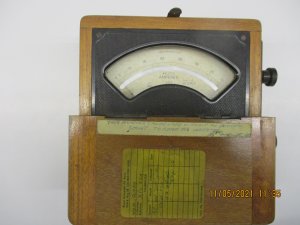
2588 - Valve Grid Dip Oscillator Model GDO-2 QMax (Electronics) London, England A Grid Dip Oscillator (GDO) is used to check the resonant frequencies of RF filters, amplifiers, and antennas or more generally as a convenient RF source. They were very popular with amateur radio operators. This GDO contains a valve in a Colpitts... |
 |
2589 - Moving Iron Ammeter 40A, Type P.I.6 A.J. William Electrical Instruments, Australia Australian made laboratory instrument for measurement of DC or mains frequency alternating currents. Range 5 - 40 A with 0.2% FSD error Used by Royal Australian Air Force in 1970s. |
 |
2590 - Voltmeter, AC/DC with suppressed scale Victorian Meter Laboratory, Melbourne, Australia Australian made laboratory AC/DC voltmeter used by Royal Australian Air Force Scales read 20 - 30, 80 - 120, 60 - 90 and separate connectors give maxima 15 VDC, 30 VDC, 90 VAC, 120 VAC. |
 |
2591 - Universal Galvanometer Shunt W.G. Pye & Co, Cambridge, England Used in DC bridge circuits to provide constant critical damping for the galvanometer while allowing the series resistance protecting it to be lowered to increase sensitivity. Resistance range 3 - 10 k ohms. Has Constantan coils for enhanced... |
 |
2592 - Double Pole, Double Throw Changeover Switch unknown, Ceramic switch mounted on a wooden base for use in teaching laboratory to change the polarity of a DC supply to a circuit. |
 |
Memcor, Rheostat with toroidally wound resistance wire on a ceramic former with most of the wire enclosed. A rotary contactor allows the resistance to be varied to control a current or it can be used as a potentiometer. |
 |
2594 - Incandescent Light Dimmer Swich 240 VAC Linda Corp P/L, Triac based dimmer for domestic lighting applications. By turning the knob, the point in every AC cycle where the current turns can be adjusted, thus controlling the power. The thermal inertia of the lamp filament smooths the flicker. |
 |
2595 - Potentiometer, 10 k ohms UQ Physics Workshop, Australia Wirewound resistor with sliding contact. 10 k ohm maximium, rated 50 mA maximum current. |
 |
2596 - Elsec Proton Magnetometer Type 592/309 Littlemore Sci. Eng. Co. Oxford, England Electronics and readout unit for magnetic field surveys. The probe and leads are missing. |
 |
2597 - Regulated Power Supply 0-50V 100 mA T.P.S. Brisbane, Australia (c. 1955) Brisbane made regulated power supply used by the Micropulsations research group in UQ Physics. voltage variable 0 - 50 V 100 mA maximum current. |
 |
unknown, Usa A high power transformer with many primary taps to allow a range of diferent mains voltages to be used to power a device designed to run on 100 V AC, probably an argon ion laser. It has US standard wiring colours of white for active, black for... |
|
2599 - Decade Resistance Box, Hundreds Muirhead & Co Ltd, England A variable resistance comprising ten 100 ohm resistors in series, to give resistances 100 to 1000 ohms in 100 ohm steps, selectable by the wiping switch. Could be combined with similar units 1-10 ohms, 1000 - 10 k ohms etc for use in bridge and... |
|
 |
2600 - Decade Resistance Box, Thousands Muirhead & Co, Ltd, England A variable resistance comprising ten 1000 ohm resistors in series, to give resistances 1000 to 10000 ohms in 1000 ohm steps, selectable by the wiping switch. Could be combined with similar units 1-10 ohms, 100 - 1000 ohms etc for use in bridge and... |
 |
Cambridge Instrument Co Ltd, England Galvanometer with moving coil and needle pivotted on a single point at its centre of mass, which makes it insensitive to accelerations. The design was used for decades, in this case configured as a millivoltmeter reading to 120 mV. |
 |
2602 - Mansbridge's Condenser, 1 microfarad unknown, A Mansbridge capacitor consisted of metal leaves iinterleaved with a paper dielectric. Should the dielectric puncture, the metal would be oxidised and thus restore insulation. There are 11 capacitors: number 10 is missing. |
|
2603 - Eveready Battery No 411, 15V Union Carbide Corporation N.Y., N.Y. 10017, Usa (c. 1950) 15 V battery of ten carbon-zinc cells with a low current output of only a few mA. Used in AVO multimeters for the measurement of high resistances. Eyelets ar each end serve as contacts. |
|
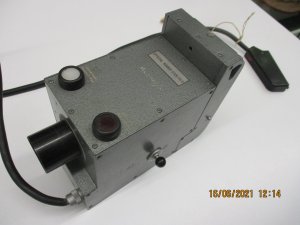 |
2604 - Film Camera for Microscope Ernst Leitz, Wetzlar, Germany Film camera for a microscope. Used in Parasitology Department. |
 |
Pye, Cambridge, England Sensitive moving coil meter used to measure very small currents, in particular to accurately find null balances with bridges and potentiometers. This one would have been used in student laboratories. |
 |
2606 - Vacuum Tube Voltmeter Type 727-A General Radio Co, Cambridge, Mass., Usa (c. 1940) A sensitivity high input impedance impedance AC voltmeter. FSD ranges are 0.3V, 1V, 3V, 10V, 30V, 100V, 300V. It uses an acorn 957 valve (tube) as a AC rectifier, and two 1S5 valves in a DC amplifier, the second one as a cathode follower with a... |
 |
Gossen, Germany An instrument for measuring ground resistance. It uses three electrodes, spaced at least 20 m apart in a straight line. The first is the test ground, the middle one is the auxiliary voltage ground and the third is the auxiliary current ground. A... |
 |
Starrett, USA, Usa Micrometer screw gauge for measurements between 2 and 3 inches (50 - 75 mm) in a home-made box. Reads to 1/1000 inch and has standard lock ring and ratchet to standardise measurement pressure. Supplied with spanner and 2 inch reference bar to check... |
 |
Cinaudagraph Corp, Stamford, Conn., Usa (c. 1945) Two Alnico horns on an iron base originally provided the magnetic field for a WWII magnetron. An aluminium plate and supports were added by UQ Physics Workshop for use in lecture demonstrations. |
 |
3585 - Dynaphon Public Address Horn Loudspeaker Type S15 Steane's Sound Systems, Melb & Syd, Australia (c. 1935) A loudspeaker for use in auditoria and picture theatres. It has a high pressure driver consisting of a 12 ohm moving coil and diaphragm and permanenent magnet, with a cast exponential horn for efficient coupling to the surroundings. |
|
unknown, |
|
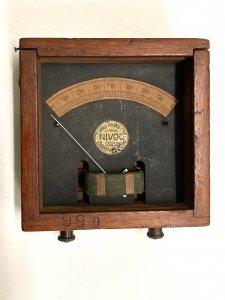 |
W & J George, Birmingham, Eng., England A simple tangent galvonometer for student use. It stamped G56, the original number of one of the ground floor labs in the Parnell Building. A tangent galvanometer is simply a magnetic compass with a coil added that generates a magnetic field... |
 |
An indicator to show the actual frequency of a mains electricity source operating at nomimal 50 Hz. A row of metal reeds with white flags on their end sits in the oscillating magnetic field produced by two coils. Each reed is weighted to oscillate... |
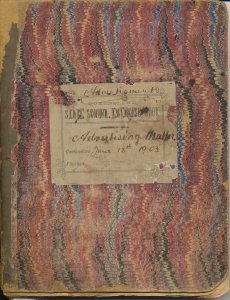 |
- Synchronome Advertising Matter Scrapbook Alfred George Jackson, Australia Scrapbook of press clippings related to the Synchronome Electrical Co of Australasia 1903-1907 |
 |
- Synchronome Installation Records 1902 -1907 Alfred George Jackson, Photocopies of the first six pages of the Installation records of the Synchronome Electrical Co. of Australasia covering the years 1902-1907. |
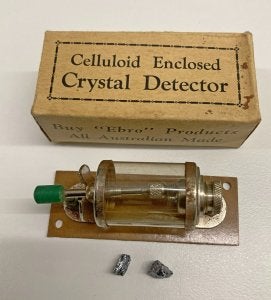 |
2702 - Crystal Detector, Celluloid Enclosed Ebro, Australia (World War 2 or soon after) A crystal detector utilises a contact between a metal and a semiconductor crystal as a diode to detect wireless signals, giving the name 'crystal set' to early radio receivers. Here, a fragment of crystaline lead sulphide (galena) is mounted at one... |
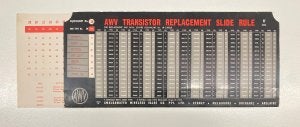 |
2708 - AWV TRANSISTOR REPLACEMENT SLIDE RULE AMALGAMATED WIRELESS VALVE CO. PTY. LTD., Australia (circa 1967) This is a chart of equivalent transistors in the form of a slide rule. One side covers audio frequency transistors (AF) and the other radio frequency (RF) types. AWV had earlier made a similar 'slide rule' for valves. AWV started as a vacuum tube... |
 |
48 - Teletype ASR-33 Model 3320 6WA Teletype, Usa (circa 1970) This item is a Teletype Automatic Send and Receive unit, made by Teletype in USA around 1970. It has a grey metal and plastic casing with a paper tape punch, keyboard, page printer, reperforator and tape transmitter. This unit could transmit... |
 |
Hilger & Watts, England, England (1960) This device is an Abbe Refractometer. A liquid sample or transparent solid can be placed between two prisms - a refracting prism below the sample, and an illuminating prism that is mounted above the sample. This entire system is rotatable, and is... |
 |
Troughton & Simms, London, England This object is a goniometer, made by Troughton & Simms around 1880. Its design is based on the goniometer developed by English chemist and mineralogist William Hyde Wollaston (1766-1828). Wollaston is famous for discovering two chemical elements... |
 |
753 - Compound Monocular Microscope Carl Zeiss, Jena. , Germany (circa 1890) This is a Carl Zeiss Compound Monocular Microscope. The Carl Zeiss Company was founded by a German scientist, Carl Zeiss in 1846 and initially specialised in single-lens microscopes. In 1857, Zeiss sold their first compound microscope. The... |
 |
EMI, England This Cathode Ray Tube Gun Assembly is a display version of the interior of an EMI cathode ray tube. It was used as part of a display in the 1970’s and 80’s, and has its principal parts labelled. It is mounted on a wooden base which is engraved with... |
 |
13 - Cathode Ray Oscilloscope Type R6673 AWA (Amalgamated Wireless Australia), Australia (before 1950) This item is an Australian made cathode ray oscilloscope (CRO), dating from around 1950. It has a very small display screen, a little over 5 cm in diameter. It has two amplifiers, one vertical and one horizontal, and adjustable focus and intensity... |
 |
E. Leitz, Wetzlar, Germany (circa 1900) This microscope is specially constructed for the study of minerals and their identification. The Ernst Leitz Company, founded originally in 1849 in Wetzlar as The Optical Institute with a focus in telescope manufacture, became world renowned for... |
 |
This item is a small tape repair tool. The device is easy to use and small enough to fit in the palm of your hand. Devices like this were widely used in the 1960’s. It consists of a base plate with a movable bar and a manual punch. The manual punch... |
 |
unknown, This item is an X-ray tube. Its maker and place of origin are unknown but it was probably made around 1900. Unlike later X-ray tubes,this tube has no heated filament. Instead, an electrical discharge was started in a small amount of gas in the tube... |
 |
W. Wilson, 1 Belmont St., London NW, England A spectrometer is used to measure the spread of colours in light. This one was made by W. Wilson in London. Light from a source enters the collimator through a narrow slit and is formed into a parallel beam before striking the prism where different... |
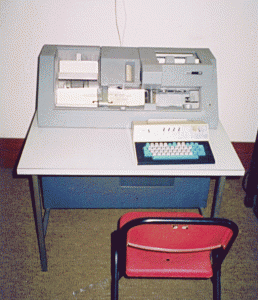 |
International Business Machines (IBM), Usa (circa 1970) The IBM 29 Card Punch is a type of keypunch device, used for the creation of punched cards in early data processing. It consists of a keyboard and card bed assembly, mounted on a desk. The card bed assembly consists of multiple parts including a... |
 |
407 - Cathode Ray Oscilloscope Type WM3 E.M.I Electronics Ltd, Hayes Middlesex., England (circa 1955) This is a Type WM3 Cathode Ray Oscilloscope, consisting of an aluminium frame with all but the front panel currently removed. The front panel contains a 3-inch Cathode Ray Tube display with a reflecting filter and graticule to eliminate parallax... |
 |
Munitions Supply Laboratories, Melbourne., Australia (1948) This microscope is a compound microscope, that was made in 1948 by the Munitions Supply Laboratories in Melbourne. It has a substage condenser and fast and slow motion adjustments on the barrel. The user has the option of two eyepiece magnifications... |
 |
1805 - Ball Bearing Crystal Model UQ Physics Workshop, Australia Crystal structure is how the spatial arrangement of atoms or molecules within a crystalline solid is described. Materials such as gold, quartz and tungsten all have set crystal arrangements. When x-rays are shone upon a crystal with a regular,... |
 |
W. Wilson, 1, Belmont St, London N.W., England This museum piece is a polarimeter. Polarimeters are used to measure the type and change of angle of polarisation that light undergoes when passed through material. It is known that light travels as both a particle (a photon) and a wave, and... |
 |
319 - Oscilloscope, Miniature, Type 301 Laboratory Electronics, Mitchelton, QLD, Australia This valve oscilloscope is considerably smaller than the others on this tour but operates on the same principles. It has a small circular screen, 6 cm in diameter and three dual knobs for controlling the beam focus/intensity, vertical gain/... |
 |
400 - Two circle reflection goniometer Stoe & Cie GmbH, Heidelberg , Germany This object is a two circle Goniometer, made in Germany by Stoe & Cie. In the field of Crystallography goniometers are used to measure the angles between faces of crystal samples. When studying crystals it is important to be able to accurately... |
 |
Cambridge Instrument Co. Ltd. England, England This Photocell camera is enclosed in a light-tight box with a camera shutter. It should be noted that this instrument is referred to as a camera, not because it takes a picture, but because it uses this shutter to control the light that enters the... |
 |
The Synchronome Co. Ltd, Alperton, Middlesex, England (circa 1955) This item is a program timer that was used in conjunction with the Synchronome clock, which is placed above this timer in the Physics Museum, to control the bells in the Parnell Building from 1955. The master clock was made in Brisbane by the... |
 |
Much like the IBM Model 29 Card Punch, this device is used to create punched cards for use in early computing. However, this is an example of a much simpler machine. Where the Model 29 took input from a keyboard and could automatically work through... |
 |
1939 - Midgard Pocket Microscope Midgard, Germany (circa 1900) This is the Midgard Pocket Microscope. This microscope has a single simple lens with a magnification of 50x and a recess into which a slide could be fitted for examination. This model, the Midgard Nr 1, was very easy to use. The user simply... |
 |
Adam Hilger Ltd., London / No. E334 301 28210, England This museum piece is an X-ray Spectrometer. It was designed by Dr Muller and made by an English firm Adam Hilger. The spectrometer was designed to be extremely compact while still being sufficiently accurate for use in classrooms. It would have been... |
 |
Tektronix, Usa This oscilloscope is a Type 561A, made in the US by Tektronix Inc around 1969. It is an indicator unit with provision for two plug-in units. The plug-in unit on the right controls the horizontal deflection on the oscilloscope's screen while the left... |
 |
55 - Cesium beam Frequency Standard Type 5061A Hewlett Packard, USA, Usa This item is a Cesium Atomic Clock, made by Hewlett-Packard, widely known today as HP, around 1970. The Cesium Atomic Clock is enclosed in a grey metal casing with an analog time display and three output frequencies. There is an embedded panel which... |
 |
93 - Linear Thermopile Detector Griffin, London, England A thermocouple is a device that generates electrical energy from thermal energy. A linear thermopile, such as this museum piece, is a set of thermocouples connected in series that produce an electric current with a voltage that is the total of... |
 |
unknown, (circa 1825) This item has been returned to its owner and is no longer on display. This is an example of a Universal Single Lens Pocket Microscope. This object was probably created in the early 1800s and strongly resembles the Pocket Microscope made by Benjamin... |
 |
1991 - Computer Card Storage Unit Caringbah, (circa 1970) This cabinet was originally used to store punched computer cards. It was supplied by the International Business Machines corporation and was made around 1970. It has 32 separate drawers and each drawer can contain up to 2000 cards. This means that... |
 |
25 - Chronometer, Electrically Wound Thomas Mercer Ltd, St Albans, England (1956) This object is a Mercer Electric Wind Chronometer P2700 (or Mercer Repeating Contact Clock MS 152 according to the manual). While the term ‘chronometer’ is often mistaken to be simply a clock, the term refers to a very specific type of highly... |
 |
THE CAMBRIDGE/ SCIENTIFIC INSTRUMENT CO.LTD./ CAMBRIDGE. ENGLAND, England (circa 1910) This item is a radio-micrometer designed by Sir Charles Vernon Boys and produced by the Cambridge Scientific Instrument Company. A thermocouple and a single turn, low resistance coil are both suspended between the poles of a horseshoe magnet by a... |
 |
Physics Workshop (?), Australia This time-lapse camera could be used to record images of cathode ray oscilloscope screens. The glow from the phosphor on the screen of an oscilloscope persists for a short time, so even if the beam passes only once across the screen to record a... |
 |
unknown, This X-ray Powder Camera is a device used for recording the diffraction patterns of x-rays caused by powdered samples. It consists of a circular metal base onto which a cylindrical cover can be placed and fastened securely using three levers spaced... |
 |
Microworld Pty Ltd. , This object is a Microbee Computer. Made by Microworld Pty Ltd in Australia in 1982. The plastic black and white case contains a keyboard and mini computer. The technology is based off a Zilog Z80, an 8 bit microprocessor that was designed in in... |
 |
Edward James Bignold, Australia (1924) The Naturscope is one of the two Australian-made microscopes on the Physics Museum Microscope tour. Patented by Edward James Bignold in 1924, the Naturscope was intended for use in the study of the natural world. Bignold aimed to provide an... |
 |
Max Kohl, Chemnitz, Germany (circa 1920) This item is a Weber Photometer. Made by Max Kohl around 1912, the Photometer is made up of large brass tubes that are connected with a rotating joint in a T-configuration. The vertical tube on the left has an eyepiece on one end and a lens opening... |
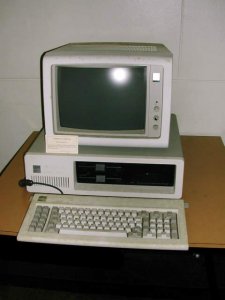 |
IBM, Wangaratta, Australia, Australia (1985) This item is an IBM XT personal computer. The computer itself is 36x13x50cm and contains two 5.25" floppy drives (360KB), 640KB RAM, 20 MB hard disk drive, 8088 processor, 8087 co-processor, 1 parallel & 1 serial port. It is missing its graphics... |
 |
396 - XRD glass X-ray tube, dismantled PANalytical, The Netherlands, This piece is an example of a standard x-ray tube. These devices have been used to produce x-rays for diffraction experiments for decades, and many of the other devices in the crystallography display in the museum rely on a source such as this. The... |
 |
456 - Camera Lucida for Microscope Officine Galileo di Milano, Italy This object was donated by the Officine Galileo (Galileo Workshops). The Officine Galileo is a major Italian optical equipment manufacturer with factories in Florence and Milan. The camera lucida is unique within this collection as it is not a... |
- ‹ previous
- 35 of 36
- next ›