|
First Moscow Watch Factory, Ussr (circa 1970?) This Poljot 6MX Marine Chronometer comes from a freighter that was broken up in Pakistan in the late 1990’s. Originally the device would have been enclosed in a wooden box, with a built-in gimbal that would keep the face of the chronometer facing... |
 |
Max Kohl, Chemnitz, Germany (circa 1912) This object is a Flicker Photometer. Inside the semi-cylindrical box is a series of rough surfaced white plates that are placed at right angles, facing away from each other. These plates are attached to a wheel and can be rotated by turning the... |
 |
397 - Single Crystal Rotation and Oscillation X-ray Camera Unicam, England, This device is an X-ray camera that is suited for taking photos of x-ray diffraction patterns and was used in the Chemistry department at UQ. Unlike the X-ray powder camera, however, this device can take images from multiple methods of x-ray... |
 |
1466 - van Leeuwenhoek Microscope (Replica) Museum Boerhaave , Other (2011) This item is a Van Leeuwenhoek Microscope. The microscope located in the cabinet is a replica of van Leeuwenhoek’s design, made by the Museum Boerhaave in Leiden in 2011. The Van Leeuwenhoek is a prime example of a simple microscope. Much like the... |
 |
112 - Lummer- Brodhun Photometer Max Kohl, Chemnitz, Germany This item is a Lummer-Brodhun Photometer. This Photometer consists of a metal box with two entrances and an eyepiece as well as a slot which allows a white magnesium carbonate disk to be mounted between the two entrances. Similar to the Weber... |
 |
Cooke, Troughton & Simms, England (circa 1960) This microscope is an example of a binocular microscope. A binocular microscope is any microscope that has two eyepieces instead of the traditional monocular (single) eyepieces that have been seen previously on this tour. The technology of a... |
 |
420 - X-Ray Equi-inclinational Diffractometer Charles Supper Inc, Boston USA, Usa This museum item is an Equi-Inclinational Diffractometer, designed by Martin Julian Buerger (MIT), built by Charles Supper Inc. It was made in Boston USA around 1970. Martin Buerger was an American crystallographer born in 1903. He invented the X-... |
 |
Ernst Leitz, Germany (circa 1960) This microscope is a projection microscope and is the most modern microscope on the tour. As its name suggests, it is a microscope that projects an image of the specimen being examined onto a screen. It was made by the same company as the... |
 |
- Talk on X-ray Crystallography Dr Colin Kennard, Slides are available below for a talk on the history of x-ray crystallography from the perspective of a chemist who worked in the field for many years. A vimeo version of the talk is available here. |
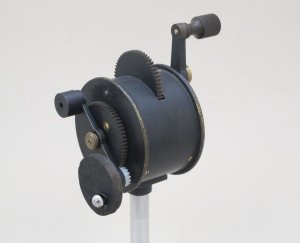 |
2016 - Wheatstone Photometer (restored) Max Kohl A.G. Chemnitz, Germany (1913?) Invented sometime before 1843, Charles Wheatstone’s photometer was praised at the time, although it was later superseded. It was based on comparing the brightnesses of reflections of two sources in a small sphere rapidly moved in a pattern so that... |
- ‹ previous
- 36 of 36